FRANKFORT — With 105 days left in office, Clinton County Prosecutor Tony Sommers says he is feeling both relief and uncertainty as he prepares to close out a career of nearly two decades as the county’s top prosecutor.
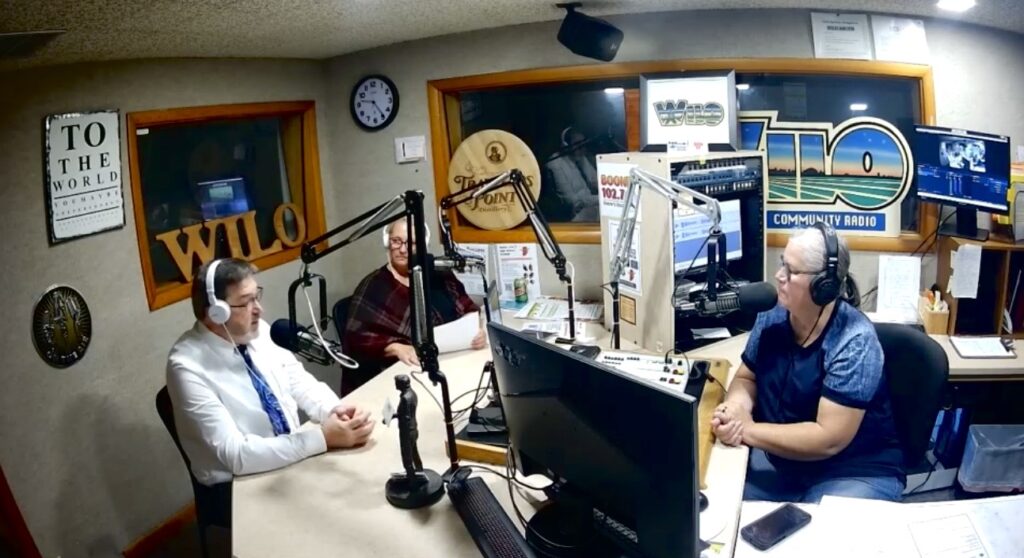
Sommers, who is completing his fifth term, appeared as a guest on Party Line on WILO and Boone’s Best 102.7, where he discussed his retirement plans, changes in local crime, license plate readers, extradition procedures and his views on term limits for Congress and the U.S. Supreme Court.
“I’m not going to be the prosecutor, but I think it’s a full retirement,” Sommers said, adding that he may leave the door open to what is known as senior prosecutor work. “Right now, no definite plans on anything else.”
He acknowledged some apprehension about the change. “There is a sense of relief,” he said. “There’s also a sense of, gee, how’s that really going to go? Because I’ve never done that before.”
Cases that stay with you
Asked about the high and low points of his tenure, Sommers pointed to the most serious cases he has tried in Clinton County.
“I think of the cases where there were serious outcomes like loss of life that I’ve had the responsibility to try here in the county over the last going on 20 years now,” he said. “Those stick with you — the way that those crimes impact survivors. The fallout is never ending.”
Drug trends shift, case counts hold steady
Sommers said the nature of local cases has changed considerably since he first took office, when much of his early work focused on dismantling a local group involved in dealing and violent crime.

“The first few years that I was in office was spent basically just taking apart that organization and prosecuting the participants for what they had done,” he said.
Since then, he said, the community has seen heroin return, followed by fentanyl and methamphetamine. Large statewide investigations and seizures have pushed methamphetamine back in recent years, he said, but another drug has filled the gap.
“We’ve seen a resurgence of cocaine,” Sommers said. “The problem is still there. The problem shifts and changes over time.”
Filings in the county have averaged roughly 1,100 cases a year during his tenure, he said, with a high of about 1,600 before the COVID-19 pandemic. More recently the figure has run between 1,000 and 1,100.
The biggest driver of case volume, he said, is not the crime rate but staffing.
“Seems like the new officers spend more time in patrol, make more arrests while they’re in patrol, we see an increase in cases,” he said, noting the increase shows up mostly in traffic offenses and low-level possession cases.
Vandalism at TPA Park
Responding to a listener question about vandalism at TPA Park, particularly in the restrooms, Sommers said cameras cannot be placed inside the facilities but can be aimed at entrances.
“You could post the cameras to cover the entrance area, so you’re definitely getting a chance to identify who is in that building and when, and that way maybe track it back to who’s responsible for any damage that’s been done,” he said.
Criminal mischief starts as a misdemeanor depending on the dollar amount of damage, he said. Such cases in local parks have often involved young people, and when suspects are juveniles the cases are handled confidentially in juvenile court.
License plate readers
Sommers said the county has license plate reader cameras in use and that they have contributed to arrests, both for traffic offenses and for other crimes where a vehicle was tracked near a crime scene.

He was dismissive of privacy objections. “Everybody has license plates on their car that are publicly displayed,” he said. “When you put that on your car, do you think nobody would ever look at it? Because police look at it all the time.”
The real change, he said, is that technology now processes that information almost instantly. Officers routinely run plates while sitting behind vehicles at stop signs and traffic lights, which helps identify drivers who are unlicensed or suspended.
How extradition works
With extradition in the local news recently, Sommers explained his office’s role. If a person waives extradition, notice goes to the Clinton County Sheriff’s Office and deputies can travel to pick the person up.
If the person fights it, his office works with the Indiana Attorney General’s Office to obtain a governor’s warrant, which requires proving the state has a case so a judge in the holding jurisdiction can rule on the request.
Extradition is available on felonies of all levels but not on misdemeanors, he said, and an outstanding warrant does not expire — a person can be picked up anywhere in Indiana. Sommers said that while some counties limit how far deputies will travel, he has left that call to the sheriff’s office, which has rarely declined the expense.
Congress, term limits and the courts
A caller criticized the U.S. House for being in session only a handful of days since the July Fourth recess. Sommers attributed the gridlock to how closely divided voters have made the chambers.
“Americans across the country have voted for deadlock,” he said. “When they’re 50-50, guess what? They can’t get anything done.”
He also noted speculation that the recess timing may have been meant to avoid a floor vote on a resolution to impeach Defense Secretary Pete Hegseth, brought by Rep. Thomas Massie.
Sommers said Congress has failed at one of its core duties. “We haven’t seen them able to actually pass a budget, which is their responsibility, by the way, and they haven’t done it for decades,” he said, criticizing the use of large reconciliation packages in place of regular order.
That vacuum, he said, has fed executive power under President Donald Trump and his predecessors alike, citing President Barack Obama’s “power of the pen” remark and the Biden administration.
On judges, Sommers pushed back on the caller’s claim that federal courts act without limits. “Judges aren’t little kings,” he said. “They don’t have influence outside of cases that are brought before them in the courtroom.” He noted rulings have gone both for and against Trump.
Sommers said he supports term limits, framing his answer through his own career.
“My initial thought when I took office was three terms was going to be enough. Instead, here I am five terms later,” he said. “There does come a time when you need to step away.”
He suggested no more than six two-year terms in the House and three six-year terms — 18 years — in the Senate. Officials who stay too long, he said, “become kind of calcified.”
He said age alone is a poor measure, recalling colleagues from his time with the Indiana State Police who were running marathons in their 60s. “One size does not fit all,” he said. But length of service on the bench, he argued, could be a bright line — perhaps 20 years, after which a U.S. Supreme Court justice would become a senior justice handling advisory work, hearings and matters such as transfer requests.
He opposed expanding the Supreme Court to 12 seats. “Court packing is just a matter of hoping that we can add some more people to change outcomes, and I don’t think that’s the right way to go,” he said.
Sommers credited the court with revolutionizing criminal procedure through due process rulings of the 1960s and said justices need tenure to manage such changes. Still, he said, positions should be revisited, pointing to the reversal of Roe v. Wade as evidence the court can re-examine major issues, and to Citizens United as a decision that “policy wise, I don’t think it’s turned out very well.”
Also on the show
Hosts reminded listeners that the 37th annual WILO Senior Fair is Wednesday at a new location, the Frankfort Clinton County Regional Airport. Admission, breakfast and lunch are free, along with bingo and door prizes, and more than 40 booths from area businesses and organizations are booked. Weather permitting, Antique cars and an antique airplane will be on display, and a shuttle will pick up attendees at their vehicles and drop them at the door.
Party Line airs on WILO and Boone’s Best 102.7 and streams on Hoosierland TV. Listeners can call 765-659-3338.