
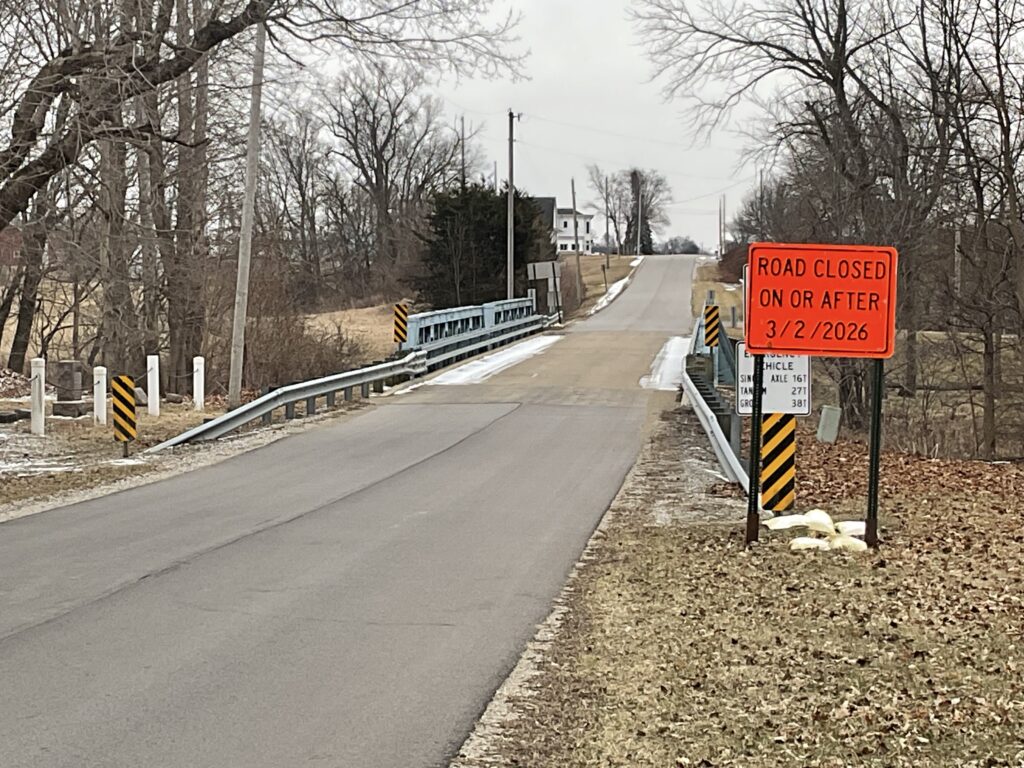
Bridge 60 Project Near Kilmore Begins March 2, Funded from Local Bridge Reserves. Work will soon begin on the historic Bridge 60 structure over Kilmore Creek, closing a section of County Road 0 by Kilmore for about six months while crews perform repairs and preservation work. The project, led by CivilCon, is funded through existing county bridge reserves rather than a new grant award, according to recent county records.
Commissioners Approved Funding Change Earlier This Year
In January, Clinton County Commissioners approved a change order for Bridge 60, which they described in public documents as the “historic bridge trusses near Kilmore.” The action authorized additional spending for the project to come from the county’s “restricted cash balances,” or bridge‑dedicated funds already held by the county.
Construction Timeline and Road Closure
At a February meeting, County Highway Superintendent Rick Campbell reported that CivilCon, a Lafayette-based contractor, is set to begin the Bridge 60 work on March first. Signage on site indicates construction will begin “On or After (Monday) March 2.” The project is expected to last approximately six months, during which County Road 0 by Kilmore will be closed to through traffic.
Campbell told commissioners that emergency services had been notified in advance and that detour arrangements will be communicated to residents. The work will focus on truss repair and structural improvements designed to preserve the historic bridge’s integrity while extending its lifespan.
How the Project Fits Into Broader Funding Programs
Although Clinton County regularly receives transportation assistance through the state’s Community Crossings Matching Grant Program, which supports road and bridge improvements, there is no record identifying the Kilmore Creek bridge as a stand‑alone, named grant project.
The Indiana Department of Transportation’s public announcements list countywide allocations — such as roughly $934,000 awarded to Clinton County in 2024 — but these lump sums typically fund multiple infrastructure priorities. The Bridge 60 work, according to local officials and public filings, is being paid from the county’s restricted bridge accounts, not from a newly awarded or named state or federal grant.
Local Preservation and Infrastructure Investment
The Bridge 60 effort reflects the county’s broader approach to maintaining its aging bridge network using a mix of state‑shared and locally controlled funds. Dozens of county bridges date back many decades and qualify for preservation rather than replacement.
Officials have framed the Kilmore Creek project as part of Clinton County’s commitment to preserving historically significant structures while keeping rural roads safe and functional. Once the six‑month work period concludes, traffic is expected to resume along County Road 0 with a fully rehabilitated span maintaining its traditional truss design.
The Kilmore bridge is classified as “historic” because it is an older county bridge whose design and materials make it eligible for listing on the National Register of Historic Places, so it must be treated as a historic structure during rehabilitation.
What “historic” means for this bridge
• INDOT’s historic-bridge program lists the Clinton County bridge over Kilmore Creek as a filled‑spandrel concrete arch from about 1917–1923 that is eligible for the National Register of Historic Places.
• Federal and state preservation rules say that when a bridge is NRHP‑eligible, any major work has to follow historic‑preservation standards rather than simple replacement, which is why the current project is described as work on a “historic bridge.”