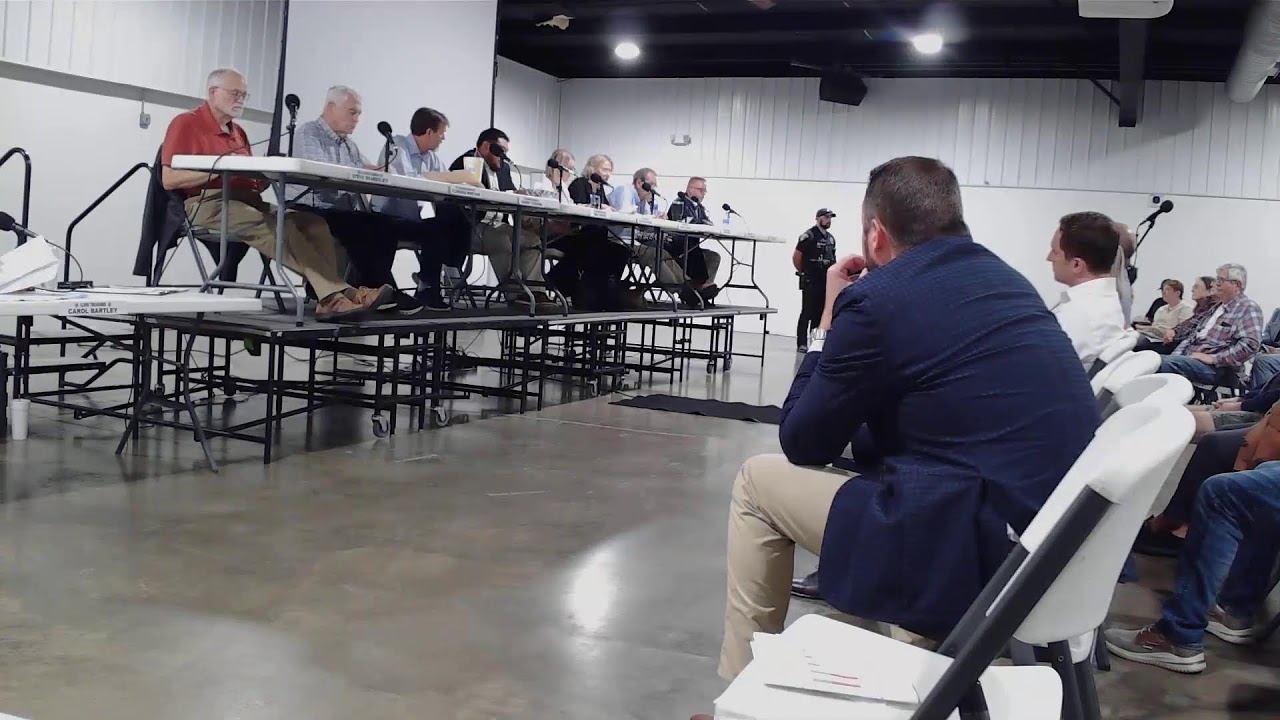
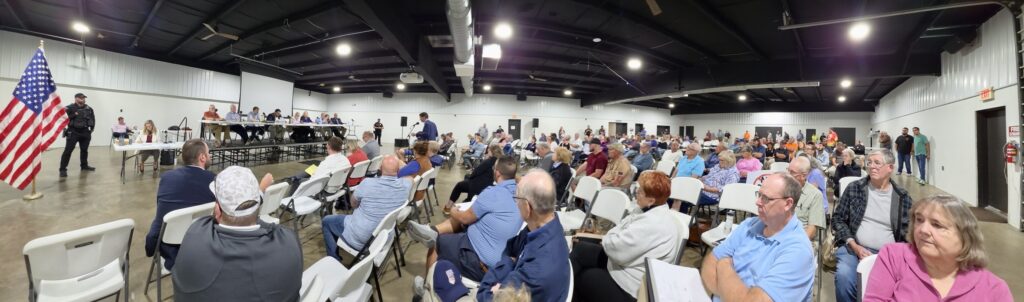
FRANKFORT — The Frankfort Common Council on Monday night approved a community enhancement agreement with DataOne for a proposed $7.5 billion AI-factory data center in the city’s industrial park. The vote came after a packed special meeting where most residents who spoke urged the council to slow down or reject the project.

Resolution 26-12 passed 5-2 Councilmen Isac Chavez and Robert Stevens were the only recorded “nays.” Council members Steve Beardsley, Clarence Warthen, Eric Woods, Taylor Crenshaw and John Large voted yes.
The special meeting was held at the Edward Jones Community 4-H Building at the Clinton County Fairgrounds. City officials stressed that the agreement is not a building permit. Before DataOne can break ground, it must deliver a noise study, an environmental impact study and a traffic impact assessment.
WHAT THE AGREEMENT REQUIRES
A summary of the agreement was read before the vote. Under the agreement, DataOne will make community enhancement payments to the city of:
– $1 million within 30 days of signing
– $1 million when the building permit is issued
– $1 million when a certificate of occupancy is issued
– $5 million by June 30, 2029
– $4.5 million a year from June 30, 2030, through June 30, 2054, rising 3% a year
The agreement also:
– requires 100 full-time jobs by Jan. 1, 2030, paying 125% of the average county wage
– caps water use at 14 million gallons a year
– requires DataOne to build a substation for Frankfort Municipal Utilities
– requires voluntary annexation before any expansion
– bars AI users from authoritarian governments
– requires a decommissioning plan to remove the fuel cells
– requires funding for fire training and equipment if the project needs it
If DataOne breaks the agreement, it loses its incentives.
In return, DataOne gets back 50% of its real property taxes for 10 years. It also receives the state enterprise IT equipment exemption. It will pay personal property tax on non-IT equipment, with a 15% depreciation floor, plus $150,000 a year in sales tax to the city. The land itself is not abated.
THE CITY’S FINANCIAL CASE
Gary Smith of Reedy Financial Group, the city’s financial advisor since about 2013, said the state’s property and local income tax reform in Senate Enrolled Act 1 will cost Frankfort about $4.3 million a year by 2030. He said closing that gap would mean cutting about 40 full-time positions, roughly 20% of city staff.
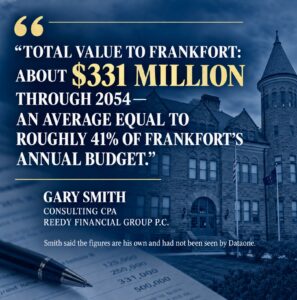
Smith said the project would be worth five times Frankfort’s entire $1.5 billion gross assessed value. He projected $331 million in revenue to the city from 2026 to 2054, or about $208 million in today’s dollars. He called that estimate conservative. He said it would fund about 41% of the city’s average annual budget over that period.
Smith put the value of the real property abatement at about $20 million over the 25-year window. The resolution lists about $825 million in real property, $6.14 billion in enterprise IT equipment and $534 million in other personal property. It is to be built by December 2029.
DATAONE’S PRESENTATION
DataOne founder and CEO Charles-Antoine Beyney said he has built 27 data centers in Europe, Africa, South America and the U.S. He said the 110-acre site would have 18 data halls. It would draw 350 megawatts from the grid through the Indiana Municipal Power Agency (IMPA) and generate another 175 megawatts on site with natural-gas fuel cells, for about 525 megawatts in total.
Beyney said the fuel cells need only a minor air permit. He said a liquefied natural gas tank on site would serve as backup if CenterPoint Energy interrupts gas service to put households first. He said the cooling system is a closed loop that uses water only when temperatures pass 104 degrees and water has to be misted onto the dry coolers. That works out to an average of about 8 million gallons a year from municipal utilities, with no on-site wells.
Beyney said the fuel cells make electricity by a chemical reaction, not combustion. He said that compared with a gas turbine, they cut nitrogen oxides by 92%, sulfur oxides by 99%, particulate matter by 82% and carbon monoxide by 67%. He said DataOne plans to deploy a carbon-transformation technology from a company he called “C Clear” around 2028 or 2029. It uses seaweed and microorganisms, and he expects it to offset “more than 50%” of the site’s CO2. He said backup LNG deliveries would take one or two trucks a day, from a storage capacity of about 35,000 dekatherms.
He said early acoustic modeling by Metropolitan Acoustics follows the ISO 9613-2 standard. It uses about 10-foot dry-cooler fans turning at 600 RPM, which he said do not produce infrasound. He said a first draft of the study arrived last Friday and will be made public. He said DataOne will pay for the transmission lines, the substation and the gas pipeline reinforcements, and that the project will not raise local utility rates. He said it will have internships for 20 to 30 people and plans local scholarships. DataOne has already contacted local companies about construction work. He expects construction to peak at about 2,000 workers over 12 to 15 months.
He committed to keeping noise at 65 decibels or less at the property line and under 55 at the nearest homes. He also promised downward-facing, dark-sky lighting with reduced temperature lighting and use of motion sensors where possible. Of the 200 permanent jobs he described, about 100 would be DataOne’s and about 100 would belong to its customer. He declined to name the customer before the project gets a building permit, saying only that it is a publicly listed American company.
RESIDENTS PUSH BACK
More than two dozen people spoke. Opponents raised concerns about water, chemicals in the cooling loop, the size of the power load, noise, light, farmland, trust and whether the jobs would go to local people.
One resident, who said she works at a church that helps residents pay utility bills, said DataOne staff at last week’s open house couldn’t tell her whether the permanent jobs would go to local people. She also asked whether an environmental impact report exists.
Deborah Pearson and Tammy Danner asked how propylene glycol, corrosion inhibitors and biocides in the cooling system would be handled and disposed of. “Public trust is not built behind closed doors,” Danner said.
Several speakers cited the $1.07 million penalty the New Jersey Department of Environmental Protection announced against DataOne’s Vineland facility over 62 natural gas generators the state says ran without air permits. Beyney said the generators were used for commissioning and that DataOne interprets the law differently from the state.
Matthew Hare compared the 525 megawatts to the 319 megawatts he said all of Tippecanoe County uses. Adrian Rauch said she filed a public records request with the clerk that day. She argued that the council’s earlier meetings may have violated the Open Door Law and asked the council to delay the vote. Mayor Judy Sheets said the executive sessions were properly advertised.
Jamie Hardesty asked for an independent review of Councilman Beardsley’s residency, citing property he owns in Wisconsin. Beardsley said he has lived in his Glendale Avenue home in Frankfort for nearly 25 years and briefly rented an apartment in the district. He said the Wisconsin cabin will be sold on Oct. 23 of this year.
Supporters included Doug Montgomery, Mike Nichols, Randy Ridgeway and Clinton County Councilwoman Carol Price. Ridgeway said he took 21 questions to the open house and got all of them answered. “It’s an opportunity that I don’t think we can turn our backs on,” Price said.
WATER FIGURE DRAWS SCRUTINY
Councilman Isac Chavez questioned why the agreement caps water at 14 million gallons when DataOne’s figure is an 8 million gallon average, calling it a 75% jump. That member also said they would not decide without an environmental study.
Beyney said 8 million gallons is the average based on the last 10 to 20 years of weather. Hotter years could push use to 14 million or more. “If you ask me to answer you honestly … this is the kind of answers that you’re gonna have,” he said.
Beyney also said DataOne has offered the four closest homeowners 20% to 30% above market value for their homes now or in the future, and that his company intends to go public in the next year or two.
Mayor Judy Sheets said the land already zoned ‘light industrial’ was meant for a second phase of ConAgra that never came. She said she was skeptical of the Data Center project at first and has been ‘screamed at and lied about during the process’. Speaking on behalf of everyone on the dias, “We love this community,” she said.
A council member Eric Woods said the money could go toward housing, grant matches for trails, workforce and trades education, and paving, without raising local taxes.
OTHER PUBLIC COMMENTS
David Riggs criticized council members who toured DataOne’s New Jersey site without going inside. He said he would recruit challengers for them. Another resident said there are more data centers in Virginia than in all of China. She called for surety and performance bonds to hold DataOne to the contract. Bill Hayes asked why a closed-loop system needs extra water and why DataOne doesn’t generate all of its own power. Jackson Hayes, the Democratic candidate for Indiana House District 41, asked, “Why did you sell us so cheap?” Tom Ayers said his family has lived in Frankfort since the mid-1800s and urged a no vote. Another resident, who works in IT at Purdue, asked whether zero-water cooling had been considered. Kimberly Duff raised concerns about the long-term risks of advanced AI. James Fitzgerald cited Lebanon’s experience with water and road wear. Sandra Sheets worried about the property values of nearby homeowners. A later speaker, Ross House , said Clinton County residents are “worth you sitting there.”
Publishers Note: It was sometimes difficult to hear each person’s name and CCDN apologizes if your name is incorrect or misspelled.
Asked whether residents could stop the project, officials said the land is already zoned industrial. Legal council said any company that follows city ordinances could build there even without incentives. They also said the city can deny a building permit if the required studies fall short.
FULL TEXT OF RESOLUTION 26-12
The mayor read the resolution in full before the vote. The text below is transcribed from the meeting recording.
COMMON COUNCIL, CITY OF FRANKFORT, INDIANA
RESOLUTION NO. 26-12
A RESOLUTION APPROVING COMMUNITY ENHANCEMENT AGREEMENT FOR DATAONE AI FACTORY PROJECT
WHEREAS, the Common Council of the City of Frankfort, Indiana (hereinafter the “Council”), is located in the City of Frankfort, Indiana (hereinafter the “City”), and holds the power to adopt resolutions for the government of the City, control of the City’s property and finances, and the appropriation of money pursuant to Indiana Code 36-4-6-18; and
WHEREAS, the City is vitally interested in the economic welfare of the citizens of the City, the creation and maintenance of sustainable jobs for its citizens, and the development of new infrastructure to serve its citizens, and therefore wishes to provide the necessary conditions to stimulate investment in the local economy, promote business, and encourage economic growth and development opportunities; and
WHEREAS, DataOne Frankfort LLC has approached the City with a proposal for the construction and operation of an AI factory data center (hereinafter called the “Project”) to be located within the corporate boundaries of the City; and
WHEREAS, the Company’s proposal was made at a public meeting of the Council, and the Company has proffered a Community Enhancement Agreement which outlines the proposed terms of the proposed Project; and
WHEREAS, the Project will consist of the construction and operation of an approximately 800,000-square-foot data center building with a total investment of approximately $7,500,000,000 to be constructed no later than December 2029, consisting of real property improvements of approximately $825 million, enterprise information technology equipment of approximately $6,141 million, and non-EITE personal property of approximately $534 million, and employing approximately 100 jobs, plus significantly more through indirect economic impact across both the construction and operational phases of the Project; and
WHEREAS, the Council, having determined that the investment in the Project and the new jobs created by the Project will have a positive effect on economic development within, and will otherwise benefit, the City, desires to support the Project and approve the Community Enhancement Agreement, which is attached hereto and made a part hereof, as presented.
NOW, THEREFORE, BE IT RESOLVED by the Common Council of the City of Frankfort, Indiana, as follows:
1. The Council approves in all respects the Community Enhancement Agreement and authorizes the Mayor to execute the Community Enhancement Agreement.
2. This Resolution shall be in full force and effect from and after its passage by the Council and approval by the Mayor as required by law.
ROLL CALL
A motion to pass Resolution 26-12 was made by Eric Woods and duly seconded.
Steve Beardsley — Aye
Isaac Chavez — Nay
Taylor Crenshaw — Aye
John Large — Aye
Robert Stevens — Nay
Clarence Worthen — Aye
Eric Woods — Aye
The resolution passed 5-2.
DataOne takes questions at its dedicated inbox and FAQ site, dataonefrankfort.com. It also posts on Facebook and YouTube.
Video of meeting: