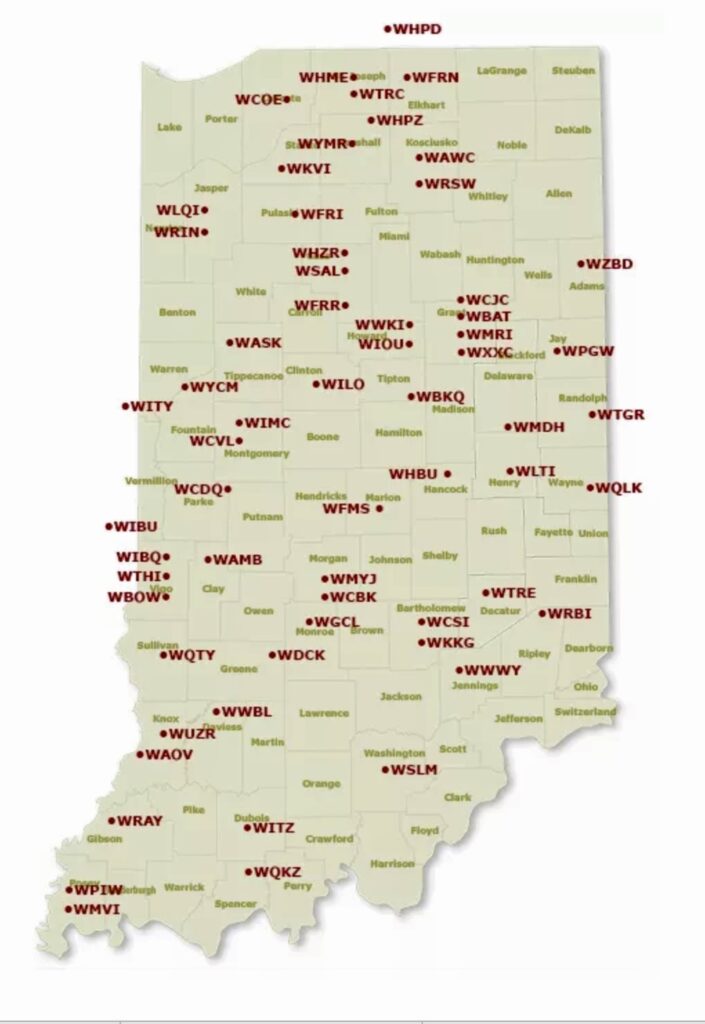
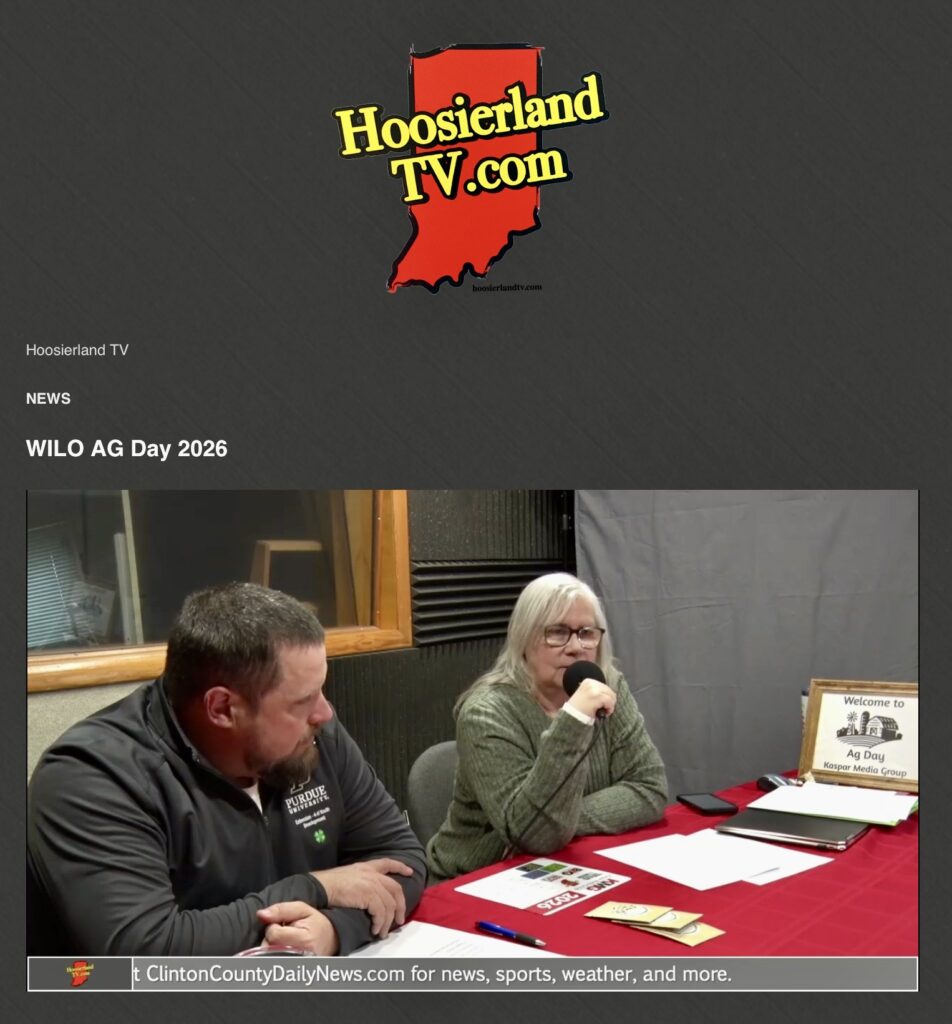
Hoosier Ag Today President Eric Pfeiffer told WILO’s Ag Day audience that Indiana farmers are being squeezed by delayed federal farm policy, rising input costs, and global turmoil—even as new state protections aim to shield them from drone harassment over livestock and cropland. He also reflected on the loss of legendary farm broadcaster Orion Samuelson and described a recent ag leadership trip to Africa that he called “life changing.”
Hoosier Ag Today at 20 Years
Pfeiffer said Hoosier Ag Today will mark 20 years on the air later this year, reaching farmers through more than 70 radio signals, daily digital newsletters, and social media platforms, including content carried on WILO 96.9 FM, WILO 1570 AM, Boone 102.7 FM and Hoosierland TV in Clinton, Carroll and Boone Counties.

“We’ve been doing it for 20 years now…bringing news, weather, market information to farmers, growers, agribusinesses, [and] politicians,” Pfeiffer said. He added that the network focuses on conditions across all regions of Indiana, as well as national developments, because farmers “like to know what other farmers are facing” beyond their own backyards.
Pfeiffer, whose background is in radio rather than production agriculture, said he feels “incredibly blessed” that Indiana farmers and ag leaders have “taken me under their wing and taught me so much about what they do and what they fight for.” He emphasized that Hoosier Ag Today, instead of being “far left or far right” is “far agriculture,” explaining, “I don’t care where the idea comes from. If it’s a good idea for agriculture, we’re going to cover it.”
Remembering Farm Broadcasting Icon Orion Samuelson
Pfeiffer also paid tribute to long-time WGN farm broadcaster Orion Samuelson, who died this week at age 91 after six decades on Chicago airwaves and national television. He recalled meeting Samuelson early in his own farm-broadcasting career at the National Association of Farm Broadcasting convention, where Samuelson encouraged him to run for leadership in the group.
“After the meeting he came up to me and he said, ‘Young man, thank you so much for doing this…If there’s absolutely anything I can do for you, let me know,’ and he handed me a small piece of paper with a cell phone number on it,” Pfeiffer said. He called Samuelson “a kind man” whose life’s work—“advocating for agriculture [and] trying to make the public aware of what agriculture means to America”—made it fitting that he passed during National Agriculture Week.
Eye-Opening Ag Leadership Trip to Africa
Pfeiffer recently returned from a two‑week international trip with Indiana’s Ag Leadership Program, organized by AgriInstitute, that took a group of 28 ag leaders and professionals to Ghana and Kenya. He said participants repeatedly described the experience as “eye‑opening,” “overwhelming,” and “emotional” as they saw widespread poverty, open sewage, and communities struggling to feed themselves.
He said government resistance to genetically modified crops is limiting food production there, even as scientific reviews have not established harm from GMO foods. “To feed that population, that’s what they’re going to need,” Pfeiffer said, noting that African officials are only now having the GMO debate that U.S. agriculture went through years ago. At the same time, he cautioned that Americans should not assume “we’ve got it all figured out,” pointing to African communities where a large share of residents are directly involved in food production, in contrast to how far removed many U.S. consumers are from farms.
Farm Bill Stalled as Costs and Conflicts Rise
On federal policy, Pfeiffer said the 2018 farm bill—intended as a four‑year law—has now been extended twice and is “double its lifespan,” leaving farmers stuck with outdated reference prices and safety net levels as inflation and costs have surged. “It’s time for this thing to get updated. It’s been time for this thing to get updated,” he said.
He noted the House Agriculture Committee, chaired by Rep. G.T. Thompson of Pennsylvania, has advanced a new farm bill on a bipartisan vote, with seven Democrats supporting it, and that Indiana has two members on the panel—Reps. Jim Baird and Mark Messmer—who “are doing a great job representing agriculture.” But he warned that Senate Agriculture leaders plan to take “the next few months” to roll out their own version, likely forcing a lengthy reconciliation and another extension beyond the current Sept. 30 deadline.
Pfeiffer said he expects California’s Proposition 12, which mandates larger confinement space for hogs and has increased pork production costs and retail prices, to be a key sticking point in the Senate. He also pointed to a separate fight over allowing year‑round E‑15 gasoline, arguing that both parties should be able to agree because higher ethanol blends would support corn demand and reduce emissions compared to today’s E‑10 standard.
New Indiana Law Targets Drone Harassment
At the state level, Pfeiffer said agriculture was not a top priority in Indiana’s recent short legislative session, but farm groups focused on stopping several “bad bills” and salvaging one important protection against unauthorized drones. Language now folded into House Bill 1249—signed last week as a broader “various criminal matters” bill—creates penalties for unmanned drones that fly over cropland and livestock barns without permission.
Pfeiffer said poultry producers in northeast Indiana reported drones flying over barns and spraying an unknown substance shortly before flocks were diagnosed with avian influenza, but local sheriffs and federal regulators previously said there was no clear law they could enforce. “Now there’s a law,” Pfeiffer said, explaining that farmers can contact the sheriff’s office when they see unauthorized drones over barns or fields. He noted there are still legal questions about how the new state restrictions interact with federal aviation rules, but called it “good news for agriculture” that farmers now have “some sort of recourse.”
Hoosier Ag Today content, including coverage of these issues, is available at hoosieragtoday.com, where listeners can also sign up for a daily newsletter and find links to the network’s Facebook, X, and YouTube channels. Hoosier Ag Today reports and commentary can be seen on Clinton County Daily News, Carroll County Daily News, Boone County Daily News and heard on WILO 96.9 FM, Boone 102.7 FM and WILO AM 1570.