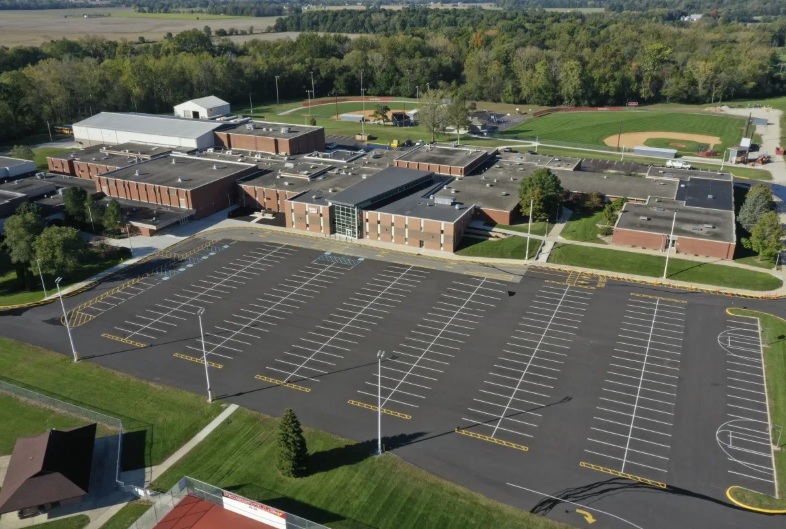
Rossville Schools leaders say growing numbers of families from surrounding districts are choosing the small, STEM‑focused Clinton County school system, even as new state testing and graduation rules raise the stakes for students and staff.
Enrollment, Transfers and Early Sign‑Ups
Rossville Elementary Principal Chad Dennison said spring kindergarten and preschool roundups drew nearly 70 incoming kindergarten students this year, with about 17 coming from outside school corporations such as Lafayette, Clinton Central, Clinton Prairie, Frankfort and Carroll.
“We’ve had a really good turnout this year so far. We’re close to seventy kids right now,” Dennison said. “Seventeen of those kids are coming to us from different school corporations, so we’re blessed to have that many kiddos.”
Dennison, who has served as Rossville Elementary principal for 21 years of his 30‑year education career, said many of those families are leaving larger districts in Tippecanoe County for a smaller, more personal setting. “They just [are] looking for a smaller community type school,” he said.
Kindergarten students must be age five by August 1 under Indiana law, but Rossville considers early entrance for four‑year‑olds who will turn five after that date. Those children complete readiness assessments at least 10 days before the school year, and Dennison forwards teacher recommendations to Superintendent Dr. James Hanna for final approval.
Higher‑Stakes Reading Tests and Retention
Both principals said state literacy and accountability rules have changed the landscape in recent years, especially around the IREAD‑3 exam in third grade. All second graders at Rossville now take the IREAD test, and new state law requires that third graders who do not pass and do not qualify for one of five “good cause” exemptions must be retained.
“We are blessed, we haven’t had to retain anybody yet,” Dennison said, noting he has heard of other schools retaining 10 to 15 third‑graders this year. “I’m mixed on retention. I think it can serve well if it’s across subject areas. I don’t always think it’s the best if it’s one subject.”
Dennison said Rossville uses ILEARN as an additional data point for decisions, but he described that statewide test, especially in math, as “very rigorous” and “not always the fairest test” in his opinion. Students who do not pass IREAD‑3 can receive up to three testing opportunities in third grade, with spring and summer windows, and committees consider factors such as prior retention, special education services, English‑learner status and other supports before deciding whether to promote a student.
STEM Certification and Curriculum Changes
Rossville Elementary is now a state‑certified STEM school, a designation the Indiana Department of Education granted in 2024 after a multi‑year effort. Dennison said the school became the only IDOE STEM‑certified elementary building in the Greater Lafayette area, including Clinton, Carroll and Tippecanoe counties.

“It was rigorous, to say the least. It took us three years to really build up to that,” Dennison said. Using state digital learning grants and a partnership with Equitable Education Solutions, the elementary invested in professional development for project‑based learning and purchased STEM curriculum built around two‑week “units of study” that integrate science, technology, engineering and mathematics rather than stand‑alone subjects.
“We believe that STEM is here to stay,” Dennison said. “It builds up into middle school, high school, and it’s one of our key priority areas.” Rossville Middle/High School uses Project Lead The Way and computer science courses to carry that STEM focus forward in grades 6–12.
New Graduation Pathways and Dual Credit
Middle/High School Principal Mike Hammonds said the state’s new diploma and accountability system is reshaping course choices and testing at the secondary level. Rossville’s freshmen are the first class on Indiana’s new 42‑credit diploma track, which requires students to demonstrate employability skills, complete a course “pathway” such as agriculture, and earn one of several seals tied to enrollment, employment or military enlistment.
“The new diploma has changed it so they can take the things that really are what they want to do,” Hammonds said. Personal financial responsibility is now a required course, and Rossville offers Indiana College Core dual‑credit options that can add up to 30 college credits for students who continue at in‑state universities.
Hammonds said teachers have completed additional training and college coursework to be certified to teach dual‑credit classes, calling their efforts “tremendous” and “a lot of work” that directly benefits students.
Extracurriculars, Mentors and Teacher Support
Both principals emphasized the role of extracurriculars and mentoring in supporting students. Fifth graders at Rossville have access to the same sports opportunities as middle schoolers—cheerleading, basketball, volleyball, track, cross country and more—along with robotics, Scouts and youth leagues backed by community volunteers. Rossville also participates in the Camp Cullom Academy of Science for selected 5th graders. This program turns Camp Cullom into an “outdoor laboratory” to study scientific method, astronomy, drone flight and technology, aquatic and woodland habitat study and other STEM related hands-on subjects.

Dennison highlighted a fourth‑ and fifth‑grade robotics team co‑coached by IT director Dustin Shadbolt and art teacher Kim Zink, funded in part by grants that Rossville hopes to expand to younger grades as more state support becomes available. He also urged local adults to consider volunteering through the Coach Kids mentoring program, saying more than 10 percent of Rossville’s K‑5 students—about 45 children—now participate.
“We have a tremendous need and we’re blessed to have a lot of mentees, but not beyond our high school mentees,” Dennison said, noting that adult mentors receive training and can choose school‑based or out‑of‑school formats.
Hammonds said Rossville uses a formal mentor program for new teachers, monthly check‑ins and open‑door administrative offices to help with retention in a competitive hiring market. “You’ve got to pretty much market yourself to the teachers as well,” he said.