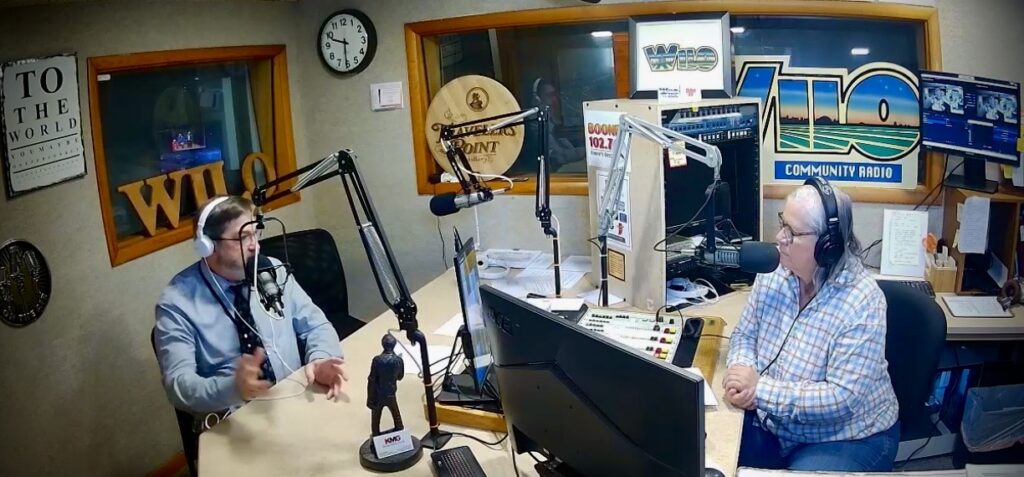
Clinton County Prosecutor Tony Sommer says artificial intelligence is already affecting local criminal cases and warns that “deepfake” sexual exploitation images are being treated under Indiana law the same as real, illicit photographs or videos.
AI, Deepfakes and Local Prosecutions
Sommer told listeners that artificial intelligence, like any technology, “can be used for good or bad,” pointing to both family-approved Hollywood recreations of deceased actors and AI-generated abuse material as examples.
“In my line of work, where we see the artificial intelligence generated images would be in sexual exploitation cases,” Sommer said. “Under the law, those are being treated as if they were the real thing, so to speak. And so if it were criminal to do it with the real thing, it’s criminal to do it with something that’s generated with artificial intelligence.”
Deepfakes are AI-generated, hyper-realistic, and manipulated audio, video, or photographic representations that show people saying or doing things they never actually did.
Sommer said his office has already handled “a couple of cases” involving deepfake‑type images and expects prosecutors will need to stay prepared as the technology spreads. “It’s not a growing concern,” he said. “It’s just a concern. It’s there. It’s like anything else in my office. We have to be prepared.”
To meet that challenge, local investigators increasingly rely on digital expertise. “We have detectives who are trained in computer forensics and they go into the data behind the data,” Sommer explained. Those specialists work to determine where an image came from, whether it is tied to a real person or generated by AI, and what servers the data passed through on its way to an end user.
Social Media, Evidence and ‘Pass-It-On’ News
Sommer said social media sometimes produces useful pieces of evidence but more often shapes the background of a case rather than the core proof. Posts by witnesses, victims or defendants may be considered like any other statement, he said, and weighed against the rest of the evidence.
“The larger impact that I see in our community right now is the heavy reliance upon social media as if it was a person’s source of news,” Sommer said. He noted that traditional local outlets—newspapers, radio and television—have faced economic pressures and receded in many places, creating a vacuum filled by informal Facebook pages and similar forums.
“We’ve seen these pages…that have sprung up and offer themselves as if they are a source of news and they’re not,” he said. “They’re just a place where people can say whatever they want to say. And they do so oftentimes with total and reckless disregard for the truth.”
Sommer compared social media rumor‑sharing to the old classroom “pass it on” (Telephone) game, where a whispered phrase becomes distorted as it moves down the line. “People are not getting facts straight and it’s really no fault of their own,” he said. “It’s just a matter of it’s all garbled to begin with.”
Backlogged Courts and Multiple Investigations
Shifting to the court system, Sommer described crowded dockets—particularly on the civil side—as a growing strain. “Many of our court systems are overwhelmed and their calendars are too full of cases and they’re not able to get to the cases quickly enough,” he said. Civil cases, he added, often take “years and years” to resolve.

He attributed delays to a mix of budget limits on courts, prosecutors and law enforcement, as well as an increasingly litigious culture. “There’s a lot more cases than can be resolved on today’s calendar,” Sommer said. “They’re stacked up, nose to tail, waiting for resolution.”
Sommer also outlined how criminal investigations can intersect with internal and administrative inquiries when multiple agencies are involved. He said criminal investigations typically go first in order to avoid constitutional problems that can arise when government employees are compelled to answer questions in internal probes. Once prosecutors decide whether to file charges, internal and administrative reviews proceed on their own tracks under separate rules.
Civil Suits, Frivolous Filings and Lack of Lawyers
Sommer noted that victims of crime may pursue civil remedies—usually tort lawsuits—on their own timetable, subject to statutes of limitation and special notice requirements when government entities are involved. Judges already have tools to deal with frivolous or repetitive filings, he said, but he does not see those sanctions used often.
“I see instances of certain persons who repeatedly file frivolous lawsuits and no repercussions to the person who does that,” Sommer said, mentioning highly litigious inmates as one example.
He also pointed to a shortage of attorneys as another strain on the legal system, especially for underserved communities. “We don’t have enough lawyers to serve the communities for the level of services that the communities apparently want,” he said. Sommer suggested law schools could do more to prepare graduates to serve specific segments of the population that now lack access to legal help.
Public Expectations and Three Branches of Government
Responding to a caller’s question about presidents or governors withholding funds or suspending taxes, Sommer said such actions are taken as executive decisions and can later be reviewed by the courts or addressed by legislatures. He emphasized that all three branches retain a role. “The legislature passes the laws and then the executive is obligated by our constitution to faithfully execute the laws and then our judicial branch determines what the laws mean,” he said.
Sommer said public frustration with the pace of justice is not new, but the system must still honor defendants’ rights and follow established procedures. Judges, not prosecutors or defense attorneys, control how quickly cases move, he noted.
He closed by encouraging residents to seek accurate information and to contact his office with questions about the law. While he cannot always give the answer people hope to hear, he said, his answers “will be based on the laws and the facts” as he knows them, and he is “more than happy” to help explain how the system works.